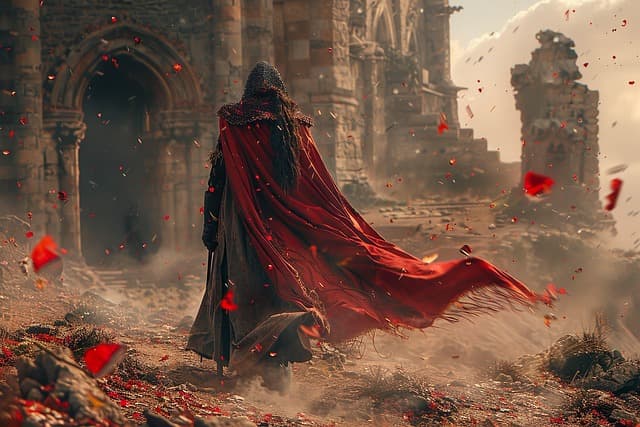
The Crimson King is one of the most mysterious and powerful figures in Stephen King’s meta-narrative. He appears in a number of the author’s works, but plays the most significant role in The Dark Tower saga. At the same time, despite his influence on the plot, he remains surprisingly inconspicuous: his appearance, motivations, and nature are only partially revealed through hints, stories told by other characters, and rare direct appearances. This secrecy makes him a particularly sinister figure — he is present everywhere, but almost never acts directly.
The Crimson King is an ancient and almost mythical creature who embodies destruction and madness. He wants to destroy the very foundation of reality by bringing down the Dark Tower, the center of all worlds and times. To do this, he sends his agents — such as Walter O’Dim (Randall Flagg), John Farson, and others — to destroy the Beams that hold the Tower’s structure together. His ultimate goal is to become the ruler of chaos, where there is no order, logic, or time. This desire is completely opposite to Roland’s desire to preserve the Tower and restore balance.
The Scarlet King’s appearance is described differently in different books. In The Dark Tower VII, he appears as a semi-ghostly, semi-insane creature with burning eyes and tufts of white hair. In fan theories and encyclopedias such as The Dark Tower Concordance, he is interpreted as a kind of analogue of Lucifer, cast out of heaven but not destroyed. His madness is the result of endless existence and the loss of connection with any morality or logic. He does not so much want to rule as to destroy everything, including himself, plunging reality into complete nothingness.
Despite the scale of his influence, the Crimson King hardly ever appears on the scene directly. This is his main difference from most literary antagonists. His actions are manifested through others: he stands behind Ventris Pickett in Hearts in Atlantis, is connected to the creature from It, and also indirectly influences the events in Despair and The Regulators. This structure makes him more than just a character — he becomes a symbol of primal chaos in King’s mythology, which unites many books into one universe.
The ending of The Dark Tower also subverts expectations: the Crimson King does not fight Roland in an epic battle, but ends up as a recluse on the balcony of the Tower, besieged by Roland and his allies. He is more like a schizophrenic god who has lost his power but is still dangerous. His destruction does not take place in a great battle, but looks like the logical end of the cycle of destruction that he himself created. According to many fans and critics, such an ending does not disappoint, but emphasizes the theme of the entire saga: evil is often not majestic, but insane and pitiful, and dangerous precisely because of this.
Thus, the Red King is an enemy who is almost invisible, but who can be felt throughout the story. He acts through fear, destruction of structure, and subjugation of time. His image is dissolved in the fabric of the worlds created by King, and his true power lies not in his physical presence, but in how he influences minds, destinies, and the very nature of reality.