The world of Stephen King’s “The Dark Tower” is not just a single dimension or a linear universe. It is a complex multi-world structure that King has been building for several decades, bringing together his numerous novels, novellas, and short stories. Mid-World is the central term used by fans to refer to the network of worlds that exist in parallel and are connected to the Dark Tower, the mystical center of the universe.
The Tower stands at the very center of all worlds — at the so-called Nexus Point. Endless realities revolve around it, each of which may be similar to our world or radically different. Stephen King has repeatedly pointed out in interviews and comments on his books that he was inspired by the theory of the multiverse and quantum physics, as well as the metaphysics of Blake and Borges. The Tower stands on a rose — a powerful symbol of beauty, destruction, and destiny — and is supported by twelve rays, each connecting a pair of Totems (for example, the Bear and the Turtle). These rays form not only the structure of the Tower, but also the “axis” of all existence.
One of the most famous Totems is Shardik, a giant mechanical bear that guards the borders of one of the worlds. Its destruction marks the beginning of the collapse of one of the Rays, a process that threatens all of reality. The idea of collapsing rays symbolizes the loss of order and the approach of chaos, the main threat in the saga.
The Interworld includes, in addition to Roland Deschain’s native world, many alternative Lands. They are governed by laws similar to those on Earth, but with some differences: in some places there is a nuclear war, in others the Sombra corporation reigns supreme, and in other worlds there are vampires, time travelers, or monsters from another dimension.
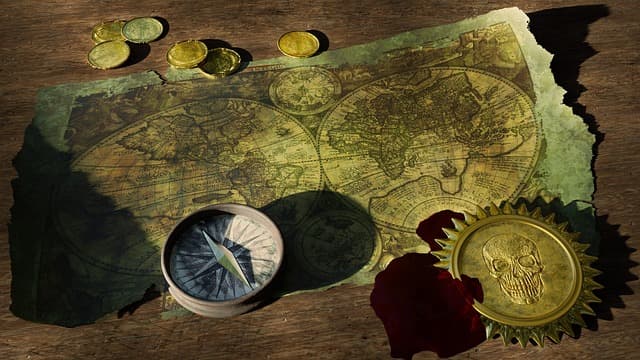
Real maps created by fans and approved by King himself (in particular, the publication “The Dark Tower: The Complete Concordance” by Bev Vincent and Robin Farting) show such key locations as Inn-Sus, Gilead, Lud, Kan-Ka No Rey, as well as territories inhabited by mutants, feral humans, and demons. These spaces are inextricably linked to the road to the Tower — the Path of the Beam, which Roland and his ka-tet follow.
Transition between worlds can occur through doors (in a literal and metaphorical sense), portals, dreams, and sometimes through deliberate disruption of reality. One example is the “Maturin turtle” associated with the book It. Characters from different King books — Jake Chambers, Father Callahan, Eddie Dean — move between worlds as participants in a great intertwining of destinies called “Ka.”
Thus, the Mid-World is not just a fantasy setting, but a multi-layered philosophical and narrative system. It combines Christian, Hindu, Taoist, and esoteric imagery, turning The Dark Tower into the center of Stephen King’s entire creative cosmos. The map of the Mid-World is, in essence, a map of his literary universe, where each place is part of a great myth about the search for meaning, order, and home.